Popular: L Hamilton |
J Button


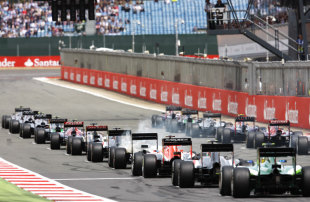
© Sutton Images
Enlarge
As a journalist, there's a tough balance to strike between being loyal to one's readers and loyal to one's metier. In addition to the delicacy of managing sources, trying not to betray any confidences while still using information gleaned off the record, there is also the question of how to use bad news.
On the one hand, the "news" that Formula One is cripplingly expensive for everyone and borderline impossible for the smaller teams is about as great a revelation as the fact that the sun rises in the east. For as long as I've been working in this sport, there have been teams in financial difficulties.
But then there are those times when concrete information about the financial status of specific teams falls into your path. As a journalist, these incidents are newsworthy, and merit publication. But to publicise the fact that one of the teams on the grid wasn't confident it had the money to turn up to Monza until the Tuesday before the race is a grey area. There's no denying it's news, but could publishing that information harm any last-ditch sponsorship negotiations that might save the team - and hundreds of jobs - in question?
It's a hard line to walk, as bad press does have the power to kill of deals and eventually kill off entire teams. But it's not one that we walk selflessly - for as much as we are concerned about the job security of our paddock colleagues, we are also concerned for our own livelihoods. If Formula One eats its teams one by one, the specialised media will also be out of a job, as there won't be a sport left to cover.
The worst-case scenario we are looking at right now is for four teams to fall off the grid between now and Melbourne 2015. While Haas will be joining the fray in 2016, there is a real - but small - possibility that Formula One will be forced into running seven three-car teams for a season, as the rules state we don't have a championship unless we have a minimum of twenty cars on the grid.
With three-car superfan Luca di Montezemolo no longer holding the reins at Ferrari there is only one person left in the paddock pushing to make the triple threat happen: Bernard Charles Ecclestone. Who, incidentally, is the only person in the paddock (CVC rarely make their presence felt at any but the most prestigious grands prix) with the power to keep all eleven teams on the road.
While the inequitable split of F1's financial spoils is currently enshrined in a selection of memoranda of understanding in lieu of the more famous Concorde Agreement, addenda can be made if agreed upon by the teams. And while there are those who would prefer to guard their precious slices of pie, the paddock bigwigs are waking up to the crisis currently engulfing our sport, and are pressing the commercial rights holder to reassess the existing agreements - such as those governing the deals with circuits - that make F1 too expensive for fans and teams alike.
The spectre of three-car teams may only be temporary for the moment, but it is something that could be avoided if those who make the most money out of Formula One wake up to the fact that their cash cow loses a little bit more value every time they try and mess around with its DNA.
© ESPN Sports Media Ltd.
 Feeds: Kate Walker

WRITER BIO
Kate Walker is the editor of GP Week magazine and a freelance contributor to ESPN. A member of the F1 travelling circus since 2010, her unique approach to Formula One coverage has been described as 'a collection of culinary reviews and food pictures from exotic locales that just happen to be playing host to a grand prix'.
RECENT POSTS
Kate Walker

Kate Walker is the editor of GP Week magazine and a freelance contributor to ESPN. A member of the F1 travelling circus since 2010, her unique approach to Formula One coverage has been described as 'a collection of culinary reviews and food pictures from exotic locales that just happen to be playing host to a grand prix'.

