
Rafael Nadal completed his career Grand Slam this week and is a great of the game. It is tough to compare eras to find the greatest of all time, but this week's Top Tens takes a look back through the history of the men's game. And no, Tim Henman has not found his way in.
Rafael Nadal
We'll start with the present and at this juncture, the Spaniard is without equal. Nine grand slams to his name by the age of 24, Nadal has propelled his game from one of clay-court slugger to all-round star with a career Slam to his name. He burst onto the scene as a teenager, winning the French Open at his first attempt in 2005. The manner of his four-set win over Mariano Puerta suggested a new era of dominance was about to start and he duly won the event for the next three years. He was discarded as a one-trick pony who would struggle on other surfaces, but his desire to take his game forward saw Nadal develop his play and he made it to the final at Wimbledon in 2006 and 2007. Roger Federer proved too big an obstacle to overcome, but Nadal learned plenty from his losses and in 2008 beat his Swiss rival to the Wimbledon crown. Injury stopped him in his tracks at the French Open in 2009 and it seemed that a great career would be cut short by suspect knees. This was reinforced when he pulled out of the Australian Open at the start of 2010 with a recurrence of his knee injury. But his iron will saw Nadal bounce back to win his fifth French Open and victories at Wimbledon and US Open followed. Nadal has played down comparisons with Federer, but he was quicker to the career Slam than the Swiss and also has an Olympic gold from 2008 and Davis Cup titles to his name.
Roger Federer
Artist is a fair word to describe Federer's skills on a court. The Swiss' talent was well known from a young age as he won Junior Wimbledon in 1998 and had his breakthrough moment as a professional when beating Pete Sampras in the quarter finals at Wimbledon in 2001. It took Federer two more years to break his grand slam duck, but he did it in style with a straight-sets win over big-serving Australian Mark Philipoussis. Many experts tipped Federer to rule the roost, but few expected the period of dominance that followed. He turned Wimbledon into a fortress by winning the title for the following four seasons. But the glorious backhand, punishing forehand, precise serve and supreme volleys translated just as well to the hard courts and US Open and Australian Open victories were racked up. The only thing missing from the CV was a French Open success and some felt it would not happen due to the dominance of a certain Rafael Nadal. But the Spaniard tasted his first defeat at Roland Garros in 2009 and Federer seized his chance by taking the title to seal his career Grand Slam. His 16 grand slams is a record.
Pete Sampras
Federer's stranglehold on Wimbledon followed on from an equally dominant spell on the grass by Sampras. Prior to the dominance of Federer, Sampras was the kingpin of tennis and spent 286 weeks as the world's No. 1-ranked player. He also held the record for number of grand slam wins at 14 and also won the season-ending Tour Finals on five occasions. Known as Pistol Pete on account of his stunning serve, Sampras was the last of the true serve-volley players, he was supreme at the net and given the advances in technology that favour the power player - we may never see his like again. But he was no slouch from the back of the court and his forehand was poetry in motion. But good as his forehand was, a weakness on the backhand wing, where he lacked real venom, saw him struggle during the clay-court season and he missed out on a career Slam by failing to win the French Open.
Bjorn Borg
The Swede is regarded as one of the finest players of all time, but his record could have been even greater as he walked away from the game when still at the pinnacle of the sport. Borg was somewhat unorthodox at the time of his career, as he played with a double-handed backhand, but he was one of the slickest movers around the court and this enabled him to capture 11 grand slam titles. He won Wimbledon five times on the spin and the French Open on four consecutive occasions. He had a superb rivalry with John McEnroe and Borg's win over the American in the 1980 Wimbledon final is viewed by many as the finest match ever played at the All England Club. The following year, McEnroe exacted revenge and it set in motion a chain of events that led to Borg's retirement. McEnroe defeated Borg again at the 1981 US Open final and the Swede walked out of the stadium before the prizegiving and played just one more tournament before announcing his retirement at the age of 26. He raised eyebrows when making a comeback in the early 1990s, but he was beaten in 12 successive first round matches, using a wooden racket instead of modern graphite, and retired for good in 1993.
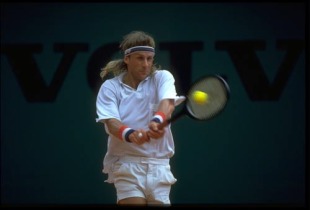
John McEnroe
For the present Nadal-Federer rivalry, the late 1970s had McEnroe and Borg to serve up classic match after classic match. Sport needs superstars and McEnroe was one, a fireball to Borg's ice-cool persona. The American made serve-volleying an art form and his tremendous shot-making skills made him a huge fans' favourite. But for all those who loved McEnroe, there were those who did not like his on-court antics as there were times when he would launch tirades at officials. On occasions the verbal blasts were out of frustration at the umpires, others at himself and were used as a vehicle to fire himself up. Either way, they often worked as he helped himself to three Wimbledon titles and four US Opens. The retirement of Borg saw Jimmy Connors and Ivan Lendl take up the rivalry and it was a defeat to the latter in the 1984 French Open final that McEnroe later admitted was the darkest day of his career - as so often he had struggled on the Paris clay and he let slip a two-set lead.
Rod Laver
There have been some great Australian tennis players over the years, Pat Rafter, Lleyton Hewitt, Ken Rosewall and Tony Roche among them, but Laver stands above them all. He has 11 grand slams to his name, but there would have been many more as he was excluded from playing in the events for five years after turning professional. He is the only player to have twice won all four Grand Slam singles titles in the same year - first as an amateur in 1962 and second as a professional in 1969. Laver was a player ahead of his time, his serve-volley game was backed up by powerful topspin groundstrokes on both wings - virtually unheard of in the 1960s. After wrapping up the Grand Slam in 1962, Laver opted to turn professional. Prior to the Open era, this prevented Laver from competing in the majors. There was a glut of great professionals, Pancho Gonzalez and Ken Rosewall among them, but Laver stood above them all and won the prestigious US Pro Championships on five occasions. The arrival of the Open era in 1968 allowed Laver, Gonzalez et al to compete in the slams again and it was appropriate that he became the first Wimbledon champion in 1968. In 1969 he won all four slams and remains the only player to have done it in a calendar year in the Open era.
Bill Tilden
Tilden was the dominant player of the post World War I period. The American was tall and athletic and this enabled him to fire down what he called "cannonball" serves and hit powerful shots from the back of the court. Tilden won Wimbledon in 1920 and 1921 with such ease that he felt there was no need to make the long journey by boat for the next five years. Fellow American Bill Johnston took up the baton in 1923 and dominated at the All England Club. Back on home soil, Johnston met Tilden in the final of the US and he was dismantled by Big Bill. Such was Tilden's authority in the match, he practiced new shots from the back of the court. He was 27 when winning the crown in 1923 but won again in 1924 and 1925. Tilden was not just an individual player, as he helped USA win the Davis Cup seven years in a row from 1920 to 1927.
Pancho Gonzalez
The story of Gonzalez is one of rags to riches, having been given a 12-cent racket by his mother and learning to play by watching people on the local courts and hitting a ball against the wall of his house. He went on to become the top professional player of the 1950s. He towered over his rivals in terms of physique, his speed around the court was beyond compare and he won the US Championships in 1948 and 1949 before turning professional. His move into the pro ranks barred him from adding to his major haul, but he dominated the ranks and was world No. 1 for eight years between 1954 and 1962. Despite his talent, he struggled with the authorities - feeling he was not being rewarded as much as players he was regularly beating on account of his Mexican heritage and patchy school record. But it did not stop him from taking tennis to a new level in the post World War II period.
Don Budge
Budge holds a record that can never be broken, being the first man in the history of the game to win all four grand slams in the same year. He achieved the feat in 1938 - with his height enabling him to generate tremendous power on serve that many of his less athletic rivals from his era could not combat. Having completed his Grand Slam, Budge turned professional and set about an era of dominance. Budge's career was interrupted by World War II and while on military service he suffered a shoulder injury that he said hampered him when he returned to the professional ranks.
Andre Agassi
American men's tennis is struggling to find a star name to jump on the back of and it could be argued the men's game in the States has been on the slide since Agassi followed Sampras into retirement. Jimmy Connors and McEnroe dominated the 70s and 80s, and in the 90s it was the turn of Agassi, Sampras and to a lesser extent Jim Courier. The rivalry between Sampras and Agassi was intense, with the former's serve-volley style in contrast to Agassi's baseline bombing. The modern rackets have enabled the greats of the current game to become fantastic returners of serve, but it is still felt that there has been no finer exponent of the art than Agassi who used to spear the ball back on both wings and loved nothing more than a target at the net. At the advent of his career, the kid from Las Vegas was famed as much for his garish outfits and blond highlights as his tennis. But that changed in 1992 when, after a number of near misses over the previous couple of years, he won Wimbledon. It was a shock for many as he had shunned the tournament for what he perceived was a too traditional approach, but he relented in 1992 and beat Goran Ivanisevic in a five-set thriller. It was his only Wimbledon crown, but he went on to add a further seven majors to his CV and completed a career Grand Slam - something Sampras never achieved - when winning the French Open in 1999.
© ESPN Sports Media Ltd.


Live Sports
Communication error please reload the page.
-
Football
-
Cricket
-
Rugby
-
- Days
- Hrs
- Mins
- Secs
F1 - Abu Dhabi GP
Abu Dhabi Grand Prix December 11-13 1. Max Verstappen ()
2. Valtteri Bottas (Mercedes)
3. Lewis Hamilton (Mercedes)
4. Alexander Albon ()
5. Lando Norris ()
6. Carlos Sainz Jr ()
-
ESPNOtherLive >>
Snooker - China Open
Tennis - Miami Open

